Improvement Science
I have experience developing and teaching courses in improvement science at the graduate and undergraduate level
HBEH 690: Rapid Prototyping
This interprofessional service-learning course prepares students to work in teams alongside community members to quickly, efficiently, and effectively develop and test innovative prototypes (i.e. preliminary versions of a solution) to help solve pressing and complex challenges. Using a participatory rapid prototyping approach, this course will make the innovation and problem-solving processes more accessible by equipping students with the skills to frame testable ideas, define measures, build prototypes, and execute experiments. It is the second course in the three course Graduate Certificate in Improvement Science.
-
The teaching team engaged in an iterative process to identify texts and learning activities to design this interprofessional service-learning course that prepares students to work in teams alongside community members to quickly, efficiently, and effectively develop and test innovative prototypes (i.e. preliminary versions of a solution) to help solve pressing and complex challenges
Using a participatory rapid prototyping approach, this course makes the innovation and problem-solving processes more accessible by equipping students with the skills to frame testable ideas, define measures, build prototypes, and execute experiments
-
Implement principles of community-engaged practices and identify strategies to involve communities in public policies and programs
Examine how quantitative and qualitative data are used to inform intervention development, adaptation, evaluation, and dissemination aligned with community needs and priorities
Develop and apply skills to enable collaboration with diverse teams from local and global communities and engage with complex problems to promote health, justice, and equity
-
Students reported that they had gained skills that directly mapped onto their real-world practice
Many students noted that they felt more equipped to navigate the emotional experience of design after the course
The practice of "making" stimulated creativity in both form and function of student design. Final projects reflected considerable iteration based on real user feedback
EDUC 472: System Improvement and Implementation at Scale
This is a collaborative, experiential, and data-driven course for understanding and facilitating organizational learning and change. Students in the class will complete an “improvement research project” based on their own personal and professional interests. Students will direct their course of study around three core questions: “What is the specific problem I am now trying to solve? What change might I introduce and why? And, how will I know whether the change is actually an improvement?” Through iterative testing, students will refine ideas based on evidence from what actually happened, develop a better understanding of the actual problem that needs to be solved, and learn how to design more feasible and context-specific interventions for change. This course will prepare students to work in complex organizations where the tasks that people do, along with the processes and tools they use, can vary substantially based on surrounding policies, structures, and norms.

-
The class will be taught in a teaching lab format in which students design, implement, and receive feedback on their improvement research projects.
Students will be assigned a series of tasks that cover the different stages of improvement science research and that encourage student reflection on and iteration of these stages. Assignments include drafting a problem and aims statement; interviewing diverse stakeholders to understand problems from an end-user perspective; conducting a root cause analysis; developing a working theory of improvement; testing change through a plan-study-do-act cycle; and implementing the 2-2-1 scanning strategy to generate rapid evidence and understanding of a problem of practice.
The improvement research projects will be scaffolded through a series of smaller assignments and students will be expected to deliver a final poster presentation at the end of the semester.
-
Students will be expected to:
Engage to frame problems of practice from a systems perspective
Conduct a root cause analysis
Develop working theories of improvement
Propose and test relevant solutions
Develop measures for monitoring change.
Students will also develop research, writing, and communication skills to undertake their personal improvement projects.
-
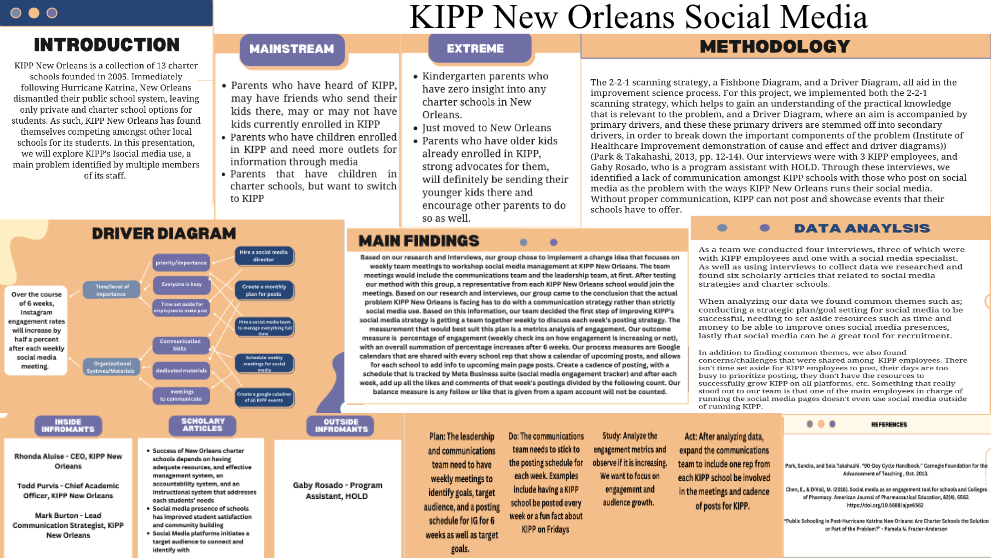
Students were grouped by topic area of interest to engage in a semester long project to engage in the process of improvement of one of their student organizations. They went through iterative problem definition, informational interviewing, and solution generation and testing with key parties.

Sample student collaborative posters, Spring 2023